Bioclimatic orientation
Containers with long axis north-south. Long facades face east-west receiving morning and evening sun, not direct solar gain. Short facades face south (controllable sun) and north (indirect light).
The site and hydrology
Before building, we read the place. Hermosillo is hot dry desert (Köppen BWh) with 365 mm of rain and summers above 45°C. The design doesn't impose — it responds.
The site
The Predio Benjamina sits in La Victoria, south of Hermosillo, on Camino al Tazajal. Industrial-residential developing zone, connected by main avenues, 12 km from city center.
It's urbanized land, not virgin terrain. This qualifies for LEED SSp1 (Minimize Site Disturbance): building on previously intervened soil is the least environmentally disruptive option.
The climate
Annual average temperature
July maximum
Annual precipitation (Jul-Sep)
kWh/m²/day solar radiation
Köppen classification
ASHRAE Climate Zone (hot-dry)
Passive responses
The building doesn't fight the desert. It reads it. Each architectural decision responds to specific climate data.
Containers with long axis north-south. Long facades face east-west receiving morning and evening sun, not direct solar gain. Short facades face south (controllable sun) and north (indirect light).
Mesquite, palo verde and ironwood placed strategically. Natural shade + heat island reduction + native wildlife habitat.
Thermal insulation 50% above Mexican NOM-020-ENER code (R-12). Significantly reduces peak thermal loads.
Low-emissivity coating blocks solar thermal gains without sacrificing natural light. Passive solar control.
Common areas with passive shading + HVLS fan for outdoor comfort without air conditioning.
Self-contained microclimate. Vegetation + shading + evapotranspiration create cool island at campus heart.
Passive hydrology
Campus CIAE containers rest on elevated concrete foundations, not on a slab. This leaves bare soil between supports and allows natural stormwater infiltration to subsoil.
It's pure LID (Low-Impact Development) design: the site's natural hydrology is not altered. July-September rains — intense but brief — infiltrate where they fall. The aquifer recharges. No runoff to treat.
→ For the full campus water cycle, see The water.
Native biodiversity
Campus CIAE green areas are 100% native Sonoran desert species. No grass. No invasive exotic species. The list includes ocotillo, agave, palo verde, ironwood, mesquite and palo brea — all endemic trees and shrubs.
This creates real habitat for local fauna: desert birds, native pollinators (including migrating monarch butterfly), small reptiles. It's not decorative landscaping — it's functional restoration within the lot.
→ Full species list at The water.
Heat island reduction
Corten steel develops dark patina. In desert climates, a large dark surface can contribute to urban heat island. Campus CIAE offsets with four strategies:
Result: SSc5 Heat Island Reduction 2/2 LEED points.
Light pollution
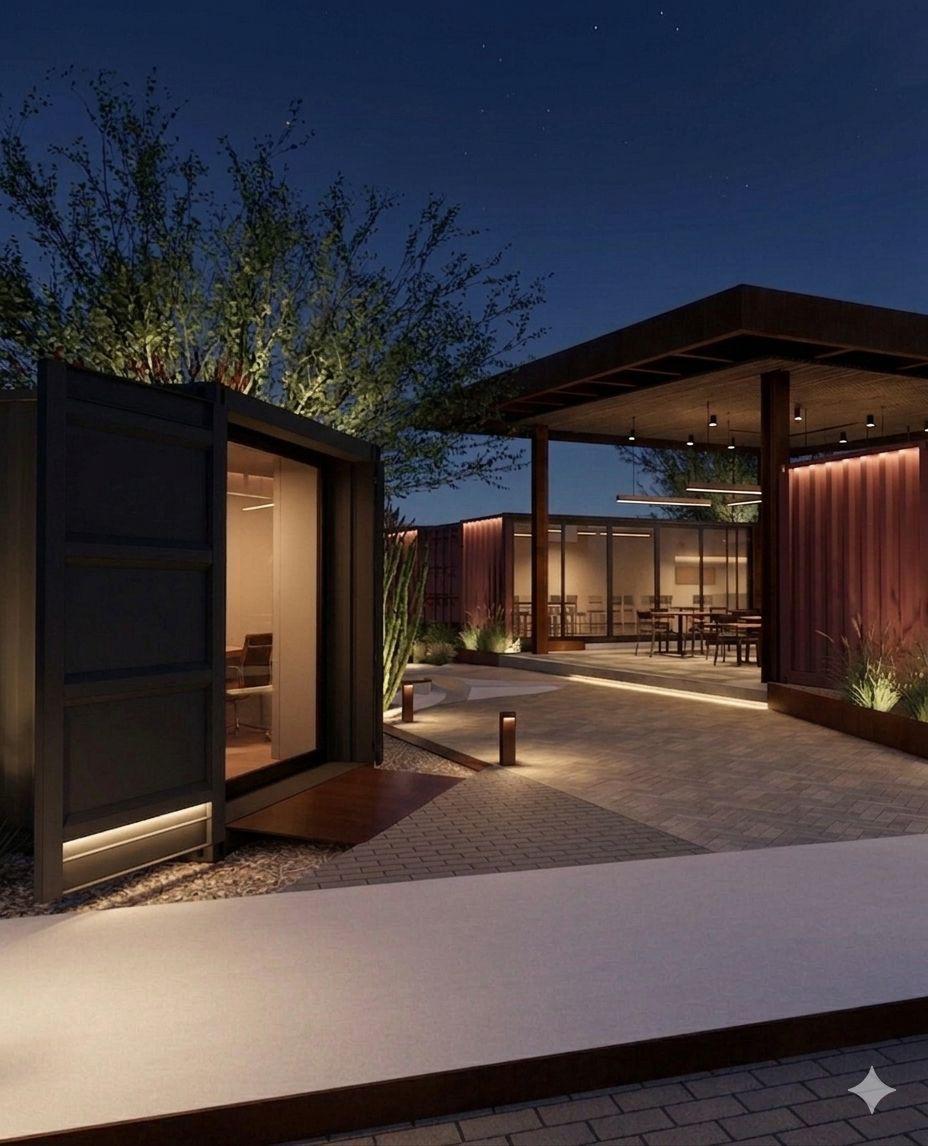
All outdoor luminaires have horizontal cut-off: directing light downward, no skyward reflection.
Lighting automatically reduces at nighttime hours via BMS. We don't light for the sake of lighting — we light where and when needed for safety or transit.
This protects Sonoran desert nighttime sky visibility, region of relevance for regional astronomical observation.
LEED v5
SS category complete at 100%: 11/11 possible points.
Project priority: PR3